AI Bid Leveling for General Contractors
Know what you're actually carrying. Piper compares subcontractor bids against the project scope, not just against each other, so you can see what is included, what is missing, and what each bid really costs before you make the call.
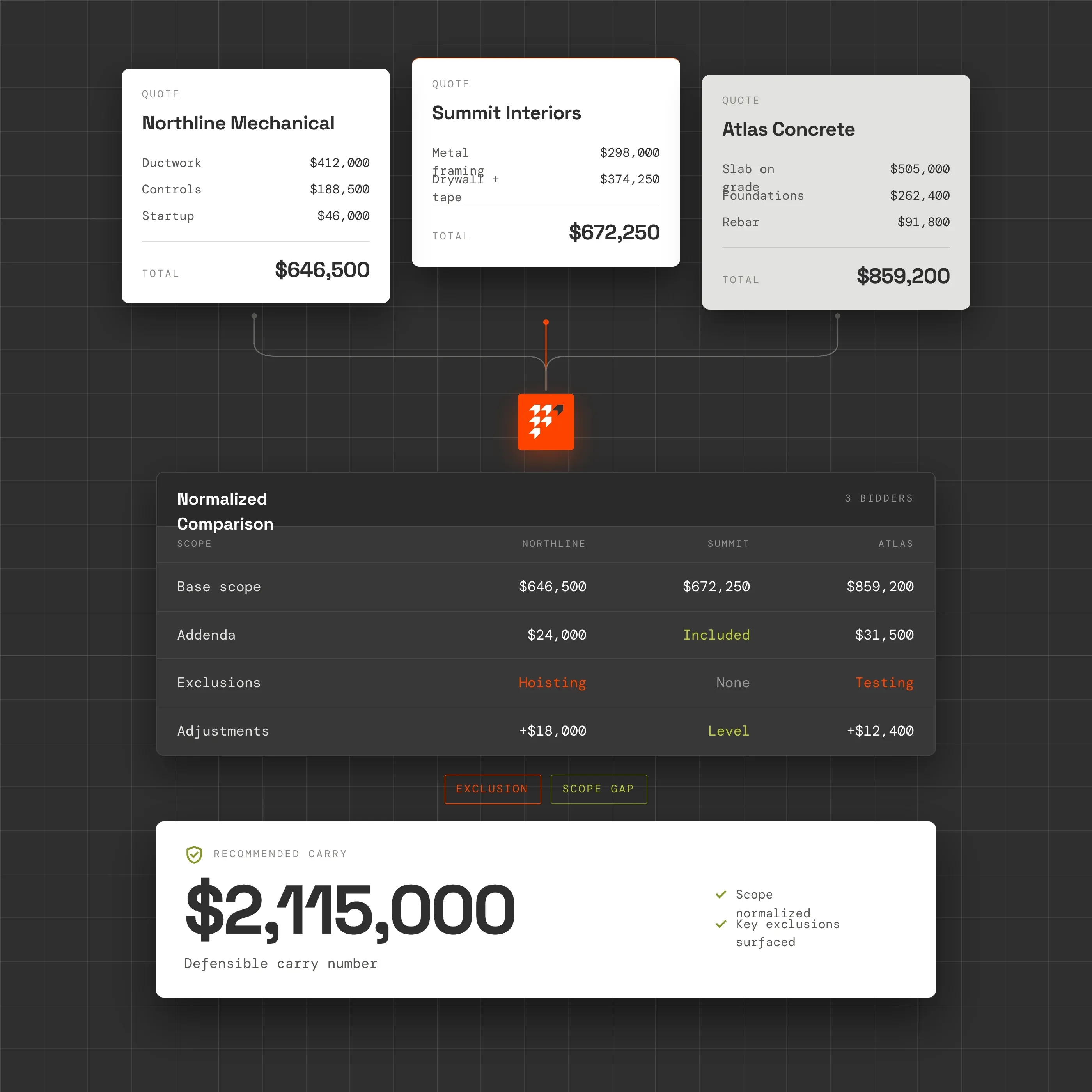
The job today
The low bid is only low if it carries the work
Subcontractor proposals rarely arrive apples to apples. One includes what another excludes. One acknowledges the latest addendum. Another leaves a scope item silent. Before you can compare the numbers, you have to understand what is actually behind them.
Today
Different quote formats. Scope buried across proposals and attachments. Hours checking exclusions, qualifications, and missing items. Manual plugs just to understand the comparable number.
With Piper
Every bid structured in one comparable view. Each proposal checked against the intended scope. Gaps, exclusions, and qualifications surfaced with their sources. Raw bid and leveled position visible before you choose a carry.
How bid leveling works in Piper
From subcontractor proposals to a carry you can defend
- 01. Bring the package together
Quotes, scope, and project requirements in one context
Upload subcontractor proposals as they arrive alongside the trade scope and relevant project information. Piper reads PDFs, spreadsheets, and attachments without requiring every bidder to follow the same format.
- 02. Understand every bid
See what each subcontractor actually priced
Piper extracts base bid, inclusions, exclusions, qualifications, alternates, allowances, unit prices, addenda acknowledgments, and other terms that affect the comparison.
- 03. Level scope and cost
Compare each proposal against the work you need covered
Piper aligns the bids to the same scope, surfaces missing or overlapping work, and shows where addbacks, deductions, or clarification may be needed to make the numbers comparable.
- 04. Make the carry decision
See the number and what is behind it
Review raw bids, leveling adjustments, open clarifications, and source-backed scope differences in one place. Piper directs attention to what needs judgment; your team decides the number to carry.
More than bid totals
Level the scope behind the number
Scope coverage
Inclusions Exclusions Missing scope Overlapping scope Unaddressed requirements
Bid conditions
Qualifications Assumptions Addenda acknowledgments Clarifications
Pricing structure
Base bid Alternates Allowances Unit prices Addbacks and deductions
Bid changes
Revised proposals Late quotes New addenda Clarification responses
Every finding stays connected to the source it came from
Outcomes
Make the carry decision with the whole picture
Compare the real number
A $2.4M bid and a $2.5M bid are not comparable until you understand what each one actually carries. Piper puts scope differences beside price so the raw low bid does not hide an expensive gap.
Catch exposure before carry
See exclusions, qualifications, missing addenda, and uncovered scope while there is still time to clarify or adjust, not after the number is already in the estimate.
Spend review time on judgment
Piper does the extraction, reconciliation, and cross-checking so estimators can spend their time deciding which differences matter and how they should be handled.
Defend the number later
Keep the proposal, scope difference, adjustment, clarification, and source behind the carry decision together instead of reconstructing the reasoning from spreadsheet comments.








Know what is behind the number before you carry it
Level a real trade package with Piper
Bring subcontractor quotes from a current or recent project. See how Piper compares them against the scope, surfaces gaps and exclusions, and helps your team get to a defensible carry faster.
Questions
What preconstruction teams ask
Does Piper replace our bid leveling spreadsheet?
Not necessarily. Piper handles the work that makes the spreadsheet valuable: extracting proposals, structuring the bids, comparing scope, surfacing differences, and supporting the carry decision. Teams can continue using their existing formats and export the work when needed.
Does Piper only compare subcontractor bids against each other?
No. Comparing two incomplete bids does not make either one complete. Piper can compare the proposals against the intended trade scope and relevant project information so the team can see where every bidder may be missing the same requirement.
How does Piper handle exclusions and qualifications?
Piper extracts exclusions and qualifications from each proposal and keeps them visible alongside the comparison. When they create a potential scope or cost difference, Piper surfaces the issue and links it back to the source.
Does Piper automatically decide what number we should carry?
No. Piper can identify differences, surface risk, and support leveling adjustments, but consequential assumptions and the final carry remain estimator decisions.
What happens when Piper cannot confidently level an item?
It does not need to invent an answer. Unclear scope, uncertain adjustments, or ambiguous proposal language can be surfaced for estimator review or subcontractor clarification.
Can we use our own leveling structure?
Yes. Piper can work with your company's trade breakdown, scope structure, and bid-leveling format rather than forcing every team into a generic template.
What happens when a revised quote or addendum arrives?
The comparison should evolve with the project. Revised bids, addenda, and clarification responses can change what is covered and which number is safe to carry, so Piper keeps those changes connected to the leveling workflow.
Keep going
Related workflows
Scope Generation
Know exactly what you're asking each trade to carry
Explore Scope GenerationFinal Bid Review
Challenge the estimate before you stand behind it
Explore Final Bid Review