AI Final Bid Review for General Contractors
Challenge the estimate before you stand behind it. Piper reviews your estimate against the project behind it: drawings, specifications, addenda, scopes, subcontractor bids, and company checks, so your team can see what may be missing, duplicated, stale, or unresolved before you commit.
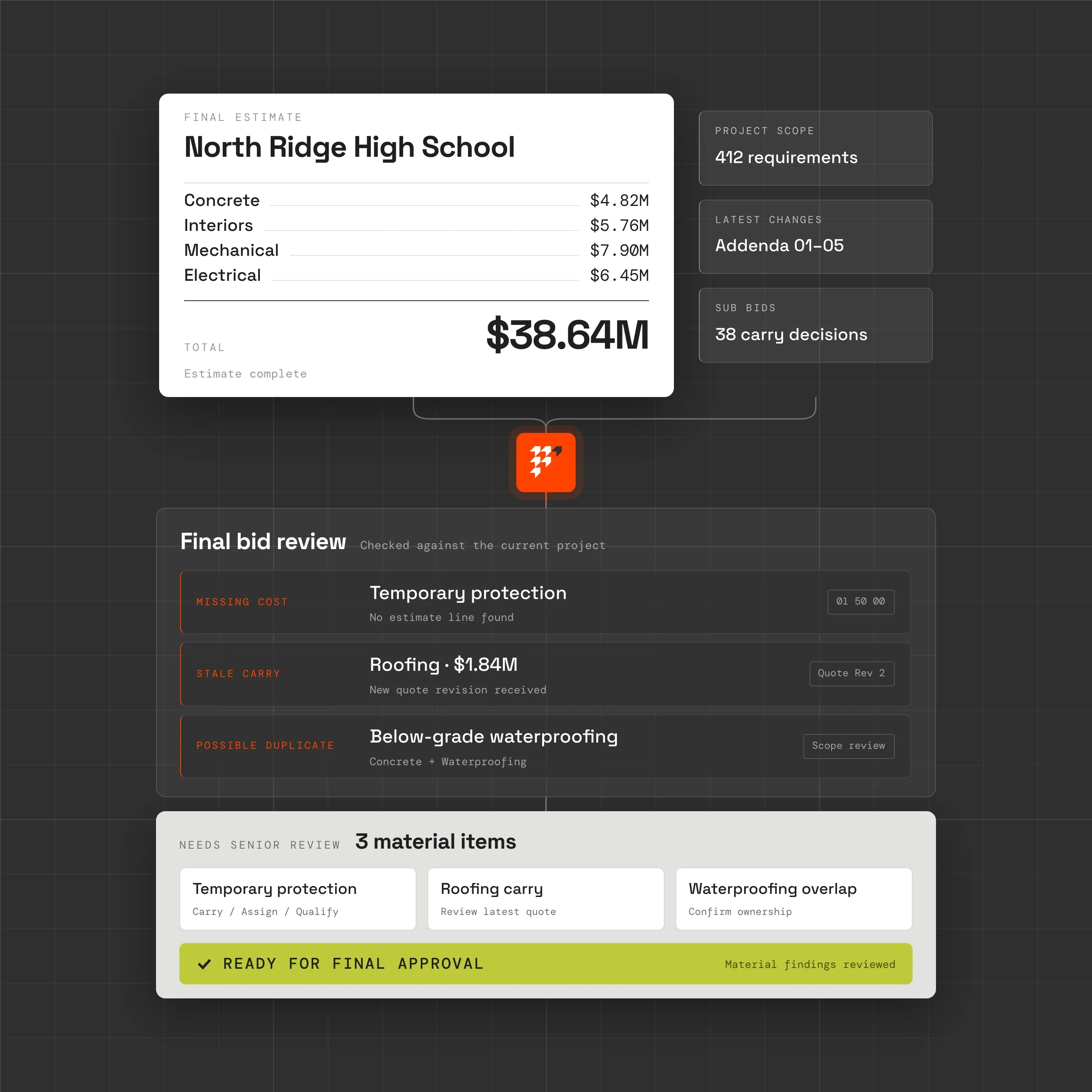
The job today
A finished estimate can still hide unfinished decisions
The estimate can balance and every line can have a number while important scope is still missing, an old assumption is still being carried, or the same requirement is priced twice.
Before submission, someone has to challenge the estimate against everything the team knows about the project.
Today
Senior estimators review thousands of lines under deadline pressure. Scope, bids, addenda, and estimate decisions live in different places. Late changes are easy to miss. Review depends on what each person remembers to check.
With Piper
The estimate checked against the current project context. Missing and duplicated scope surfaced for review. Stale or unsupported carry decisions called out. Senior attention directed to the issues that actually need judgment.
How Final Bid Review works in Piper
From a finished estimate to a submission your team has challenged
- 01. Connect the estimate
Bring the number together with the project behind it
Piper reviews your estimate alongside drawings, specifications, addenda, trade scopes, subcontractor bids, and other relevant project information instead of treating the estimate as a standalone spreadsheet.
- 02. Trace what you're carrying
Understand what sits behind the estimate
Piper connects estimate lines to the scope, pricing source, subcontractor coverage, allowances, plugs, and project requirements that support them.
- 03. Challenge the estimate
Look for what does not line up
Piper cross-checks the current estimate for missing scope, duplicated cost, uncovered requirements, stale information, inconsistent assumptions, and other conditions that deserve another look.
- 04. Focus the final review
Put senior judgment where it matters most
Instead of asking a reviewer to reperform the entire estimate, Piper surfaces and prioritizes the open issues, with the evidence behind each one. Your team decides what to change, accept, qualify, or carry.
More than arithmetic
Review the commitment behind the total
Scope coverage
Unpriced requirements Unassigned scope Trade-package gaps Duplicated scope Scope carried outside the expected package
Pricing support
Subcontractor carry numbers Allowances and plugs Leveling adjustments Missing quantities or pricing Unsupported estimate lines
Project changes
Latest addenda Revised subcontractor bids Updated scope decisions Changed assumptions Potentially stale work
Open decisions
Unresolved clarifications Risky assumptions Low-confidence items Items requiring senior review Decisions not yet reflected in the estimate
Every finding stays connected to the source behind it
Outcomes
Submit knowing where the exposure still lives
Catch what the total does not show
A complete-looking estimate can still contain missing scope, duplicated cost, stale assumptions, or unsupported numbers. Piper challenges the work behind the total before those issues become commitments.
Give senior reviewers somewhere to start
Chief Estimators cannot re-read every drawing, re-level every trade, and reperform every estimate. Piper directs their attention to the areas where experience and judgment matter most.
Review the latest project, not yesterday's version
Late addenda, revised quotes, scope changes, and new clarifications can invalidate work that was already considered finished. Piper helps surface where those changes may affect the current estimate.
Keep the reasoning behind the final number
See the source, scope, pricing basis, and open issue behind material findings so the final review is based on evidence, not someone's memory of how the number got there.








One more set of eyes before the number becomes a commitment
Run Final Bid Review on a real estimate
Bring an estimate from a current or recent project. See how Piper reviews it against the project, surfaces what still deserves attention, and gives your senior team a more focused final review.
Questions
What preconstruction teams ask
Is Final Bid Review just another estimate check?
No. Arithmetic is only one small part of the problem. Piper reviews the estimate against the project information behind it to find conditions such as missing scope, duplicate coverage, stale decisions, and unsupported carry assumptions.
Is this the same as bid leveling?
No. Bid leveling asks whether subcontractor proposals are comparable and which number is safe to carry. Final Bid Review steps back and asks whether the project-wide estimate makes sense before the company commits to it.
Does Piper replace the Chief Estimator's review?
No. Piper gives the reviewer another set of eyes across the project and directs attention to issues that deserve judgment. Decisions about scope, risk, assumptions, contingency, and the final submitted number remain with the team.
How does Piper know if scope is missing from the estimate?
Piper can compare project requirements and trade scope against what is currently represented in the estimate. If required work appears to have no corresponding cost or clear treatment, it can be surfaced for review with the supporting source.
Can Piper catch something carried twice?
Piper can surface potential overlap where the same requirement appears to be represented in multiple trades or estimate lines. The estimator determines whether that overlap is intentional or a true duplicate.
What happens when an addendum or revised quote arrives late?
The latest information can change work that was already reviewed. Piper helps identify where updated documents, quotes, or scope decisions may have made existing estimate assumptions stale.
Does Piper automatically change our estimate?
Not simply because it finds an issue. Piper surfaces the finding, explains why it may matter, and connects it to the supporting evidence so the estimator can decide how the estimate should change.
Can we apply our own review process?
Yes. Company review questions, standards, templates, and lessons learned can become part of the checks Piper applies instead of limiting the team to a generic checklist.
Keep going
Related workflows
Scope Generation
Know exactly what you're asking each trade to carry
Explore Scope GenerationBid Leveling
Know what you're actually carrying
Explore Bid Leveling